 Central Maine Astronomical Society
 Check the
 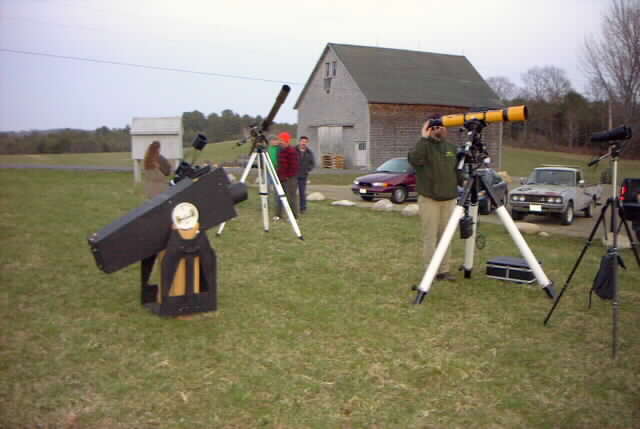 Amateur Astronomy clubs frequently open their facilities and knowledge to the public, and many, including The Central Maine Astronomical Society were organized around this mission.
Newspaper articles, radio or TV, website or email notices are ways that may have brought notice to you of a gathering, often called a "Star Party". You might say, "Sounds interesting, but I really
haven't attended one, and aren't sure what goes on there." Below is a quick outline of what you might expect to find, what to bring, and what to do when you get there.
Amateur Astronomy clubs frequently open their facilities and knowledge to the public, and many, including The Central Maine Astronomical Society were organized around this mission.
Newspaper articles, radio or TV, website or email notices are ways that may have brought notice to you of a gathering, often called a "Star Party". You might say, "Sounds interesting, but I really
haven't attended one, and aren't sure what goes on there." Below is a quick outline of what you might expect to find, what to bring, and what to do when you get there.
GENERAL GUIDELINES
- Children/minors are certainly welcome and must be attended by their parent or legal guardian, as stated in our club By-Laws.
- We discourage pets, as there may be a problem of loss, or conflict.
- A telescope is not essential. Bring your interest, your curiosity, and meet some fine people.
- Donations for our non-profit activities are welcomed.
- Smoking around the scopes is discouraged. The smoke particles will condense on the optics, and lighting up usually blinds the dark-adapted eyes of others.
- Large groups (8 ∓ up) should notify the host or club officer before arriving, to help with site planning.
- Observing begins at dusk, and may go until dawn. Best to arrive early and get familiar with the site, the equipment, and best of all, the astronomers. If you plan to arrive after 10:00 p.m. notify the host.
FINDING AND ARRIVING AT THE SITE:
Typically it is in a rural area, and maps and directions are essential. CMAS provides directions to the major sites on our website. Review these directions and if there is any doubt regarding the directions, please call one of the listed contact people. When arriving at the site, it is courteous to cut your headlights and proceed slowly on parking lights only. It may take 10-20 seconds to let your eyes adjust, but it can be done. Many cars are now equipped with constant headlight operation. I have heard that if you pull the parking brake up one click, it is possible to extinguish the headlights and still drive. Parking should be marked, and a short walk may be required to the observing area. Flashlights are useful, but may blind other observers whose vision is dark adapted. Masking the lens with your hand will do in a pinch. Better is to place some red transparent or translucent paper of film over the lens, or a red flashlight, sold through Orion telescopes, a local camera store or other outlets.
TELESCOPE ETIQUETTE
Most telescope operation is simple, and there is little danger of damaging a scope while observing. The following is a general guide:
DON'T
- Force any scope if it doesn't want to move.
- Put your finger on any optics.
- Operate a scope by yourself unless you get permission from the operator.
- Shine bright lights.
DO
- Ask the operator of the scope what's in the view and step up to the scope or get in line.
- Ask how to look through, and what to expect.
- Find the focuser knob and adjust it to your particular vision. Essential for enjoyment.
- Take your time, if there is not a long waiting line. The more you observe, the more you see.
- Ask to see something that piques your curiosity. North star, a double, a galaxy, a nebula, etc.
- Ask what, why, how.
WHAT TO BRING
The list will vary, depending on the season, and how you wish to participate.
WARM CLOTHING
Even in summer, the night can get chilly while sitting or standing at telescopes, and more clothing, rather than less is the rule. Multiple layers work best, and you can don more as the night cools. A brimless hat is ideal, such as a wool ski hat, beret, as a brim will get in the way at the eyepiece of a telescope. In warm weather, long sleeved shirts, and long pants provide the best combination of insect, draft and rough ground protection.
WARM FOOTWEAR
In cool weather, winter boots are ideal. The ground is often cold and much discomfort can result from poor shoes. In winter, the warmest possible boots are essential. Open sandals may not provide good protection against insects, rough ground or dewy grass. The current trend in light hiking boots is suitable in most observing conditions.Non-aerosol formulas are ideal, as the accidental spraying of a telescope will not be welcomed. Strong formulas are best, and if preferred, dabbed on the clothing around your ankles, wrists, neck and head. Initially the bugs at a site can be intimidating. As the evening wears on, the bugs seem to disappear. Certainly early spring, fall, and winter are choice bug free times.
BUG PROTECTIONDedicated lavatory facilities are not usually available and one should inquire what the options are. Prepare to be rustic for general needs. Certainly in the case of urgencies/injuries, the host can make facilities available to you. Consider these needs before you arrive, and your comfort will be enhanced. Waterless hand wipes and tissues are useful, and a zip lock bag for any carry home needs is a simple tool. Children must be escorted/assisted by their legal guardian for their safety.
PERSONAL NEEDS
ADDITIONAL/ OPTIONAL EQUIPMENT
BINOCULARS
Almost any pair of binoculars can be used to show a great many objects. Scanning the sky from a comfortable seat is wonderful. The 4 Galilean moons of Jupiter, craters of the Moon, comets, and many deep sky objects are visible. 7 x 50 is an optimal size. Bring whatever you have and someone will help you spot some fine objects.Bring whatever you have. Many attend star parties just to see if they can get their scopes to actually work! Most gatherings have "experts" on using most any scope. We may have never seen your particular scope, but we'd love to get it working for you. There will be many scopes already there so having a scope is not essential.
TELESCOPESUseful to locate fixed or moving objects like comets asteroids or outer planets. Some charts are on laptops, some are fixed paper based charts. A planisphere is a dial type device that presents a chart of what is currently visible. They are inexpensive and can be ordered from Orion Telescopes.
STAR CHARTSA folding chair or chaise is useful to get you off your feet, socialize, or allow you to scan the sky in a relaxed manner.
FURNITUREWe do not allow alcoholic beverages on site. Coolers and thermoses are a great way of making the best of the evening.
BEVERAGES/FOODIt may be useful to bring blankets or a sleeping bag. Some events are visible in the wee hours, and a few hours nap, or an early a.m. rising may be just the trick. Check with the individual host whether this is feasible at the site.
SLEEPING GEAR